

Start taking things more personally
Nonchalance and corporate stoicism are stealing your personality

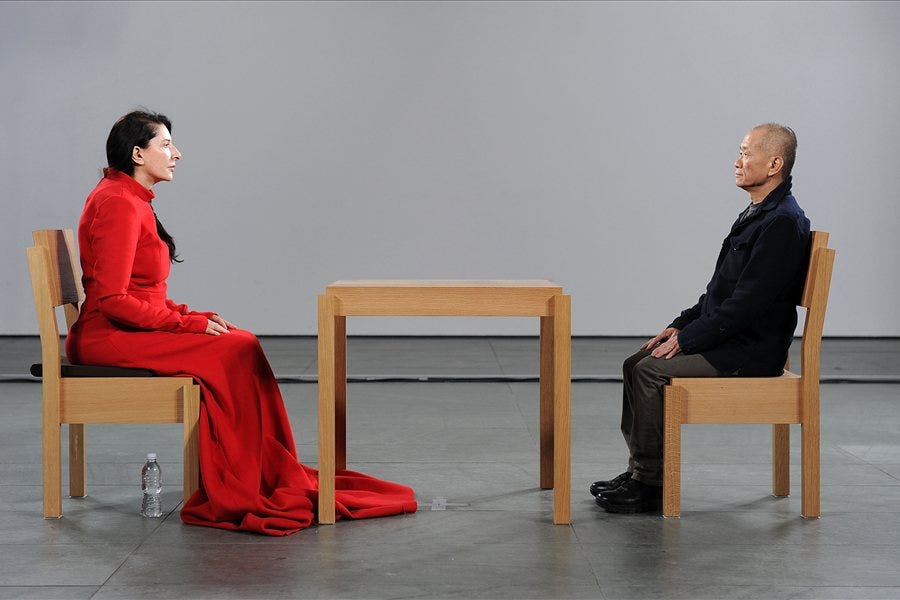
The three moments game is a powerful acting exercise in the Meisner technique. You sit across from your acting partner, knees nearly touching, and say out loud, back and forth, what you notice about each other. The statement or question should be something deliberately provocative like you look like you stole money as a kid or you wish your dad loved you more.
The point is to notice the person in front of you and form an opinion that’s true to how you see them and that carries enough energy to cause a genuine feeling of surprise or in the other person. It gets under their defenses and as they repeat it back to you, you can glimpse how they feel about what you said.
Three weeks ago, a man I had known for forty minutes looked at me and said, “You really like managing me.” I smiled at him with a warm, generous, twelve-years-of-corporate-performance smile, and repeated the statement back to him. My teacher stopped the exercise.
He said my smile was a defense, a thick wall built with good manners and survival instincts. In life, taking things less personally, deflecting, and appearing cool keeps us out of trouble but in acting, it wouldn’t serve me well. He would rather watch me be insulted or shocked or amused than watch me handle my feelings. An audience will forgive almost anything except being handled.
I scribbled ‘take things more personally’ in my class notebook and underlined it twice, because he was right. I recognized the smile. It is the one from VP review meetings, and it is, together with sarcasm and you-think-you-can-hurt-me energy, part of my meticulously built armor.
The note under the note
But it was this that I chewed on for the whole ride home on the train. He was telling me that my most rehearsed reflex, the one I am proudest of, the one that got me promoted four times in less than double that time, is what makes me painfully boring to watch.
This is not only about acting. Not taking things personally can turn you into a machine that’s painfully dull to interact with, and we now have ChatGPT for that.
Coming together or coming apart
One thing about good stories (whether in film or life) is that they are about one of two things: intimacy or conflict. Coming together or coming apart.
A story only works if someone lets the other person land a blow. Not (always) literally. In a scene, the actor who has privately decided that nothing will actually touch her gives the audience nothing but competence. And competence, on stage just like in corporate America, is invisible.
You cannot play ‘falling in love with your rival’ from a professional distance. You cannot argue with your friends who’s the best soccer team in the World Cup without taking it personally. An argument between two people who don’t care is just a friendly match where nothing is at stake and nobody remembers the score.
We are way too unbothered
“Don’t take things personally” has been drilled into us for years, disguised as sage advice by productivity gurus and twenty-six year old life coaches with a podcast. It’s something your mom probably said when a kid called you fat or stupid or weak in school (or maybe that was just my experience of growing up in Eastern Europe). These days, it’s become a corporate compliment: she doesn’t take things personally.
TikTok spent the past year relitigating the word nonchalant. First came the tutorials on how to seem effortlessly unbothered, then the counter-movement, Gen Z proudly declaring themselves chalant, like they were coming out as having a pulse. The teens are at least honest about the mechanics. Caring so much about appearing like you don’t care at all is the truest definition of cringe.
The adult version is much subtler, but better paid. I don’t know a single woman who hasn’t at least once deleted that one exclamation point from a two-line email so she wouldn’t seem too eager, then followed it up with “no worries if not” under a request she was genuinely worried about. The same applauded indifference applies to everything from dating to texting your friends in a group chat. At a birthday party just last week, my friend described her date as unbothered and above it all, not sweet or kind or charismatic. I thought we used to reserve that for monks and house cats, neither of which is famous for intimacy.
When an entire culture rehearses stoic detachment at the same time, somebody is profiting from the rehearsal, and I don’t think it’s us.
Stoicism is a management strategy
Stoicism is the house philosophy of the modern workplace. Ryan Holiday sells it to CEOs and NFL locker rooms by the stadium-full. Marcus Aurelius gets quoted in all-hands decks by people who have not read past the introduction. Epictetus, an actual Stoic, told his students that life is a play and the accomplished actor performs whatever part she is given “with impartial skill.”
Every actor you admire, and for that matter every creative person, would set that sentence on fire. “Impartial skill” is the precise thing no audience has ever bought a ticket for.
On the flipside, the workplace benefits here. An employee with impartial skill takes the reorg well. She controls what she can control and shows up Monday morning ready to be helpful, excited to present last quarter’s numbers (even though she’s drowning in laundry, the political shitshow, and hasn’t slept more than two hours cause her neighbor is a hobbyist DJ). The stoic philosophy gets marketed as inner freedom but it functions as compliance with a sexier label.
Taking it well is unpaid labor
I have a theory that the whole stoic project is a way of keeping us away from ourselves.
The spring my product area got gutted at Google, I sat in the town hall taking clean notes while a VP spent twelve minutes retiring three years of work. Afterwards a director I admired said, “You took that so well,” a sentence I lived on for a week before understanding it was a receipt. I had absorbed the entire cost of the write-off privately, off the clock, no tears in the bathroom, no hard questions in the Q&A.
Taking it well was unpaid labor, and my composure was a line item they had learned to count on.
It was also a lie, because I would tell my manager “I take my work seriously, I don’t take it personally” while, in the side chat, three of us typed in lowercase fury about what had just been done to our roadmap and our roles.
When the file on you goes thin
In acting class last week, we were asked to invent a difficult task we deeply cared about, plus real stakes if we fail to finish it perfectly and on time. I chose to storyboard a marketing campaign for the AI glasses I used to work on, at a company I no longer work at. For fifteen minutes I measured the size of the frames, counted screws, and drew the results and believed I was fully connected to my imagined circumstances.
My teacher called the result pedestrian, which in his dialect means spectacular failure. He knew I didn’t really care because there was nothing in my behavior that looked like I cared. I went back to my seat and spent the last hour of class trying to name one thing I give a damn about for real.
Sanford Meisner believed your immediate reaction to something is information about who you are. If you sand those organic impulses down for a living, the file on you goes thin. Your personality slowly seeps away and you forget what you like and don’t like. You don’t let anything land on you, whether it’s a reorg with your name in the appendix or a dog at a party choosing your lap out of every available lap.
By my last year at Google I could give you my opinion on a product roadmap but my opinion of my own life ran about two sentences deep. I started therapy with an unusual records request: I would like access to my own file. Locate feelings and restore access, please.
Years of efficiently metabolizing my emotions, swallowing each feeling whole so nobody had to watch me have it, left me with just one feeling: detachment.
None of my heroes are nonchalant
Detachment describes an empty room where nothing really happens. None of my heroes live there.
James Baldwin took everything personally. He took American racism personally, took the church that raised him personally, took his lovers personally. He absorbed all of it into sentences that still cut deep, sixty years later. He did not transcend feelings; he refined them into something beautiful that moved the world.
Joan Didion was the same. She registered the wind in a Vegas wedding chapel, the emptiness in a Malibu breakfast, and she never once lost the sentence. She allowed herself to be open and permeable, take in what she saw, without armor, so that she can deliver a precise critique.
Marina Abramović sat across from 1,500 strangers over the course of 700 hours and took every single one of them personally. That was the entire piece.
I’m learning to take things more personally again because I want to create things. Writing and acting both require the exact material I trained myself to swallow, and so does a life with a personality and a pulse.
Last Monday, the same man sat across from me again, knees nearly touching, and said, “You look sad tonight.” I felt the smile arrive, right on schedule, the muscles practiced and ready to help me hold onto the lie. I let it go.
My eyes went hot, and he watched it happen, and the room went so still I could feel the stillness like a blanket. My teacher didn’t stop us. There was nothing to fix.
Cheers, Kira
A song about heartbreak written after the songwriter took time to compose themselves first would be... probably bland. I'm a creative at night but a "professional" by day, and I've definitely noticed that the composure that carries my day to day has quietly bland-ified my art
<3 <3 <3
You said it on LinkedIn, but asking questions (not even just hard questions) truly felt like it was frowned upon and people responded like you were trying to create an issue, out of just trying to get clarity (also coming from the big G).
This was fabulous, really. To less nonchalance. <3